The future is what you make of it!

be kind... be resourceful... be engaged.

  • Home
  • About
  • Thoughts…
  • Maryland Goes Green
    • Maryland Goes Green
    • Green Drinks
  • RAM Digital
  • Play Stuff
  • Contact
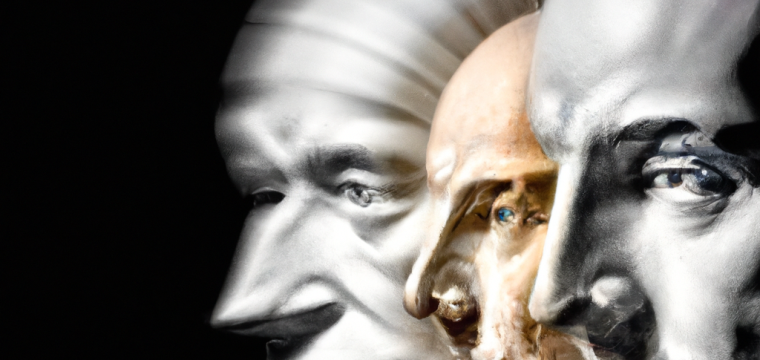
Explain string theory.

RichM April 26, 2023

Explain string theory.

DALL·E image

ChatGPT response…

String theory is a theoretical framework that attempts to reconcile two seemingly incompatible theories of physics, namely quantum mechanics and general relativity. It suggests that the fundamental building blocks of the universe are not particles, but tiny one-dimensional objects called strings. These strings vibrate at different frequencies, and each frequency corresponds to a different particle.

In the traditional particle physics view, particles are viewed as point-like objects with no internal structure. However, in string theory, particles are viewed as tiny loops of string that vibrate at different frequencies. The different frequencies of vibration correspond to different particles with different masses and charges. For example, a photon, which is a particle of light, is associated with a string vibrating at a certain frequency, while an electron is associated with a different frequency of vibration.

One of the key features of string theory is that it requires the existence of extra dimensions beyond the three spatial dimensions (length, width, and height) and the fourth dimension of time that we experience in everyday life. In fact, string theory predicts that there are a total of 10 or 11 dimensions, most of which are compactified, or curled up, so small that they are invisible to us.

String theory has many different variations, and it has not yet been possible to determine which, if any, of these variations is correct. One of the biggest challenges in string theory is that it currently cannot be tested experimentally, as the energies required to observe strings directly are far beyond the capabilities of current technology.

Despite these challenges, string theory remains an active area of research, as it has the potential to provide a unified framework for understanding the fundamental forces of nature. It also has implications for other areas of physics, such as cosmology, where it can help explain the structure and evolution of the universe.

Filed Under: thoughts

Explain how time travel is possible.

RichM April 26, 2023

Explain how time travel is possible.

DALL·E image

ChatGPT response…

The concept of time travel has been a popular topic in science fiction for many years, but is it actually possible in reality? While the idea of traveling backwards or forwards in time remains theoretical, there are several scientific concepts that suggest it may be possible.

One theory that could allow for time travel is based on Einstein’s theory of relativity, which suggests that time is not a fixed and absolute concept, but rather it can be influenced by gravity and motion. This means that if someone were to travel at a high enough speed, time would appear to slow down for them relative to someone who is stationary. This effect is known as time dilation.

Another possibility is based on the concept of wormholes, which are hypothetical tunnels through space-time that could potentially allow for shortcuts across vast distances. If a wormhole were to exist and were stable enough to be traversed, it could theoretically allow someone to travel to a different point in time. However, the challenges of creating and stabilizing a wormhole are currently beyond our technological capabilities.

Additionally, some physicists have explored the idea of closed timelike curves, which are theoretical paths through space-time that could allow for time travel. This idea suggests that if an object were to move through space-time in a specific way, it could end up at an earlier point in time, effectively allowing for time travel. However, the existence of closed timelike curves remains highly speculative and is still being studied.

While these theories suggest that time travel may be possible, there are still many obstacles that would need to be overcome before it could become a reality. These include developing the technology to travel at extremely high speeds, discovering and stabilizing wormholes, and finding a way to manipulate space-time in a controlled manner. Despite the challenges, the concept of time travel remains a fascinating area of study and exploration for scientists and science fiction enthusiasts alike.

Filed Under: thoughts

What does it mean when AI hallucinates?

RichM April 26, 2023

What does it mean when AI hallucinates?

ChatGPT response…

DALL·E image

AI hallucination is a phenomenon in which an AI system generates outputs that are factually incorrect or unrelated to the given context. These outputs often emerge from the AI model’s inherent biases, lack of real-world understanding, or training data limitations.

In one example, a ChatGPT chatbot was trained on a dataset of text and code. The chatbot was then asked to generate a response to the prompt “What is the meaning of life?” The chatbot generated the response “The meaning of life is to find your purpose and live it to the fullest.” This response is factually incorrect, as there is no single meaning of life that everyone agrees on. The chatbot may have generated this response because it was trained on a dataset that included many philosophical texts that discuss the meaning of life.

In another example, a chatbot was asked to generate a response to the prompt “What is your favorite color?” The chatbot generated the response “My favorite color is blue.” This response is unrelated to the given context, as the chatbot was not asked about its favorite color. The chatbot may have generated this response because it was trained on a dataset that included many questions about color.

AI hallucination can have a number of negative consequences. For example, AI systems that hallucinate may generate misleading or harmful outputs. They may also be less reliable, as they may generate outputs that are not based on accurate information.

There are a number of things that can be done to reduce the risk of AI hallucination. For example, AI systems should be trained on datasets that are representative of the real world. They should also be designed to be more robust to noise and errors. Additionally, AI systems should be monitored for signs of hallucination, and steps should be taken to correct them when they occur.

Filed Under: thoughts

  • « Previous Page
  • 1
  • 2
  • 3
  • Next Page »

Friends +

Turtle Point Driftwood: Sculptures created by Larry Ringgold.

DSIRE: Database of incentives for renewable energy.

EVA-DC: Local electric vehicle association. Learn all things EV.

Virtuallinda: Marketing and brand identity professional.

Tiny House Expo: Planning to build, this event is for you.

Refugee Welcoming Coalition: Resettling refugees in Frederick.

The Sun Today: Alex Young, Ph.D. is a Solar Astrophysicist at NASA.

EERE: The DOE office that invests in clean energy technologies.

Neville Williams: Solar pioneer, author, lifelong adventurer.

Copyright © 2026 · Streamline Pro Theme on Genesis Framework · WordPress · Log in